
Advancements in telerobotic surgery are occurring globally, offering the possibility of expanding access to emergency and specialized care in regions with limited surgical staff. Physicians, medtech firms, and government bodies increasingly recognize telesurgery’s potential to deliver critical care to those without timely access to life-saving or disability-preventing treatments.
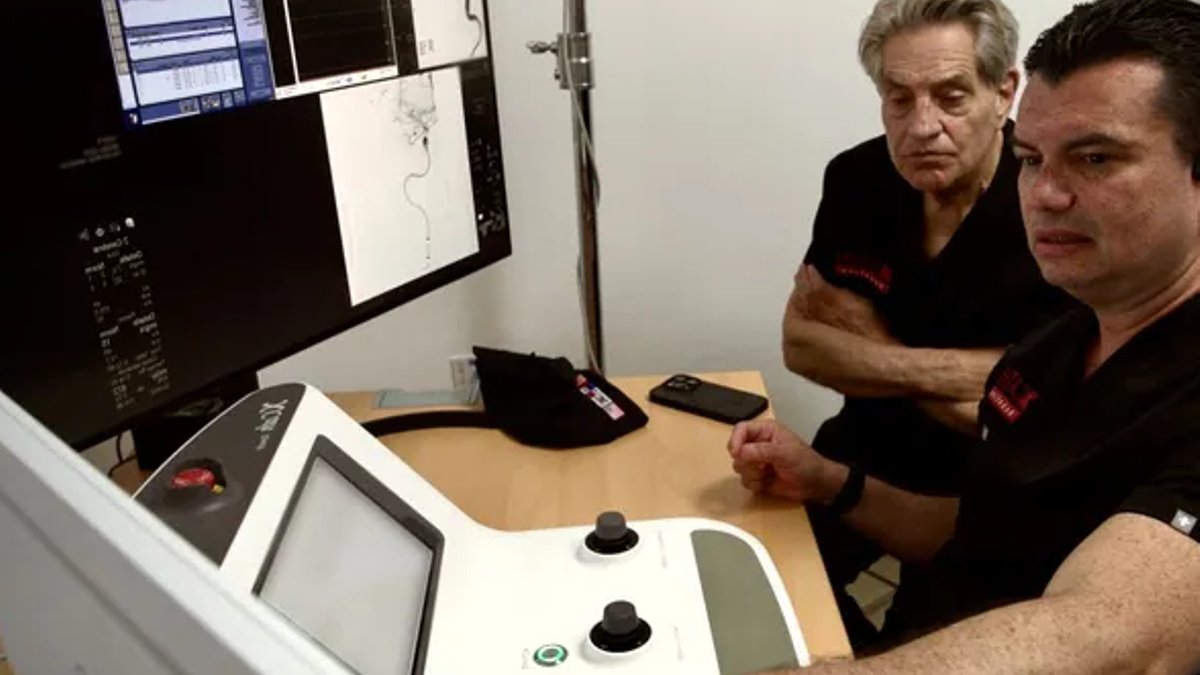
In a recent example, neurosurgeon Vitor Mendes Pereira performed the world’s first telerobotic neurosurgery on a patient in Panama. The patient, Felipe Rios Mendoza, had suffered a severe ischemic stroke and was diagnosed with a blockage in a major artery of the brain. Pereira, sitting at the controls of XCath’s system in Santiago, Panama, performed a telerobotic mechanical thrombectomy, assisted by clinicians at the patient’s bedside.
Telerobotic Surgery Expands Access to Care
The procedure was a success, with Rios Mendoza talking and moving again just two hours later. Remote stroke treatment, in particular, could have a significant impact, as over half of Americans live more than an hour from a stroke center capable of providing thrombectomy.
According to the Advanced Research Projects Agency for Health, the U.S. agency awarded up to $175.3 million to a group of universities and companies to develop robots for long-distance thrombectomy procedures. The FDA is also closely watching the progress of companies developing telesurgery capabilities, with robotically assisted surgical devices appearing on the latest list of proposed guidance documents.
Vipul Patel, a urologist who completed a transatlantic prostatectomy in June 2025, operating from Florida on a cancer patient in Luanda, Angola, believes that telesurgery will fundamentally change the way surgical care is provided to patients and the way surgeons are educated. “The reason is, it is so much easier if you are able to operate or teach remotely from one location to another,” said Patel.
Challenges and Opportunities
While robotic surgery has entered the mainstream, telerobotic surgery remains in its infancy, with roughly 5,000 remote surgeries performed around the world to date. The FDA has granted breakthrough status to XCath for the Iris robot used in Rios Mendoza’s procedure, and top medical device companies such as Medtronic, Johnson & Johnson, and Intuitive are laying the groundwork for a day when telerobotic surgery could become a viable option for more patients.
Read Also: Urinary incontinence linked to frailty in women
However, challenges such as credentialing, licensure, and reimbursement considerations are hurdles in the path to wider telesurgery adoption. Having a feasible backup plan for handling dropped signals or latency problems will also be important. Mischa Dohler, vice president for emerging technologies at Ericsson, said that networks today are extraordinarily reliable, with fiber optics backed up by 5G wireless networks to give hospitals redundancy in their systems.
SS Innovations’ Sudhir Srivastava acknowledged that building trust with patients will be a process, as people are used to having a surgeon in the operating room. But he believes that telesurgery benefits patients by reducing the expense, uncertainty, and trauma that comes with traveling long distances to receive advanced medical care. The company’s SSi Mantra system has been used in over 185 robotic telesurgeries, including more than 25 cardiac telesurgeries.
The FDA spokesperson wrote in an email that the agency is committed to advancing innovation of robotic medical devices, including robotically assisted surgical devices and endoluminal navigation devices with robotically assisted components for remote procedures. The spokesperson also noted that the agency intends to develop guidance documents for these devices, which will help to ensure their safe and effective use.
Intuitive is developing telesurgery technology for da Vinci 5, its latest-generation system. The company believes the long-term value of telesurgery lies in expanding access to experience while helping healthcare systems reduce variability and improve consistency of care to support patient care across distance.
Industry Developments
Medtronic’s Hugo robot allows surgeons to use telepresence to consult with colleagues via live streaming during a procedure. The company’s technology enables surgeons to invite potentially any surgeon worldwide to join them in a case. James Porter, chief medical officer for robotic surgical technologies and digital technologies at Medtronic, said connecting surgeons remotely during surgery is already transforming the culture of education and training and fueling borderless collaboration.


