
“`html
The Essential Checklist for Health News: Navigating the Sea of Medical Information
In an era where information travels faster than a virus, discerning fact from fiction in health news has become a critical life skill. Every day, we are bombarded with headlines claiming a “new miracle cure” for cancer, a “superfood” that melts fat overnight, or a “hidden danger” in our common household items. While some of these reports are based on groundbreaking science, many are exaggerated, misinterpreted, or based on flawed studies.
Misinformation in health reporting isn’t just annoying; it’s dangerous. It can lead to unnecessary anxiety, financial loss from ineffective supplements, or, in the worst-case scenarios, the avoidance of life-saving medical treatments. To help you navigate this landscape, we have compiled the ultimate health news checklist. Use these criteria to evaluate the next health story you read before you share it or change your lifestyle based on its claims.
1. Analyze the Source: Who is Telling the Story?
The first step in evaluating health news is identifying the origin of the information. Not all platforms are created equal. A post on a social media “wellness” page does not carry the same weight as an article from a university or a major medical institution.
- Is it a primary source? Reputable health news should link directly to a peer-reviewed study published in a medical journal (e.g., The Lancet, JAMA, or NEJM).
- Who wrote the article? Look for the author’s credentials. Is it a specialized medical journalist, a doctor, or a general news reporter? Specialized writers are less likely to misinterpret complex data.
- Is the website reputable? Check if the site ends in .gov, .edu, or .org (from recognized non-profits). If it is a .com, ensure it has a robust editorial policy and high transparency.
2. Look Beyond the Headline
Headlines are designed to grab attention—a practice known as clickbait. Often, the headline makes a definitive claim that the actual study results do not support. A headline might scream “Coffee Prevents Heart Attacks,” while the study only suggests a correlation in a specific demographic under specific conditions.
Correlation vs. Causation
This is perhaps the most common trap in health reporting. If a study finds that people who drink green tea live longer, it doesn’t necessarily mean the tea is the cause. It could be that green tea drinkers also tend to exercise more or smoke less. A credible health news report will clarify whether the study proved causality or merely found an association.
3. Evaluate the Study Design
The “gold standard” of medical research is the Randomized Controlled Trial (RCT). However, many news stories are based on much weaker forms of evidence. When reading the details, look for the following:
- Human vs. Animal Studies: Many “breakthroughs” are actually results from mice or cells in a petri dish. While these are important for science, they very rarely translate directly to human biology. If the news doesn’t mention humans, be skeptical.
- Sample Size: A study involving 10 people is a pilot study, not a definitive conclusion. Reliable results usually require hundreds or thousands of participants to rule out coincidental findings.
- Study Duration: Chronic diseases like heart disease or Alzheimer’s take decades to develop. A study that only lasts six weeks cannot tell you much about long-term prevention.
4. Identify Conflicts of Interest
Follow the money. Scientific research requires funding, and where that money comes from can sometimes influence the results—or at least the way they are framed. A study claiming that dark chocolate improves cognitive function loses some credibility if it was funded by a major confectionery corporation.
Reputable health news will disclose who funded the research. If the article fails to mention the funding source, you should look up the original study to see if any Conflicts of Interest (COI) were declared by the researchers.
5. Understand Absolute vs. Relative Risk
Health news loves to use percentages because they sound dramatic. You might see a headline saying, “Eating Processed Meat Increases Cancer Risk by 20%!” This sounds terrifying, but it refers to relative risk.

If your absolute risk of getting a specific cancer is 5 out of 100, a 20% increase means it goes up to 6 out of 100. The risk is still very low. Always look for the absolute numbers to understand how the news actually affects your personal health.
6. Peer Review: The Quality Control of Science
Before a study is published in a reputable journal, it undergoes peer review. This means other experts in the field have scrutinized the methods and conclusions. During the COVID-19 pandemic, many studies were released as “pre-prints”—papers that had not yet been peer-reviewed. While this speeds up information sharing, it also means the findings haven’t been “fact-checked” by the scientific community yet. Be cautious with pre-print results.
7. The “Miracle” Red Flag
Science is an incremental process. It moves in small steps, not giant leaps. Words like “miracle,” “cure,” “breakthrough,” and “secret” are red flags. If a health discovery sounds too good to be true, it almost certainly is. Real medical progress is usually characterized by cautious optimism and calls for more research.
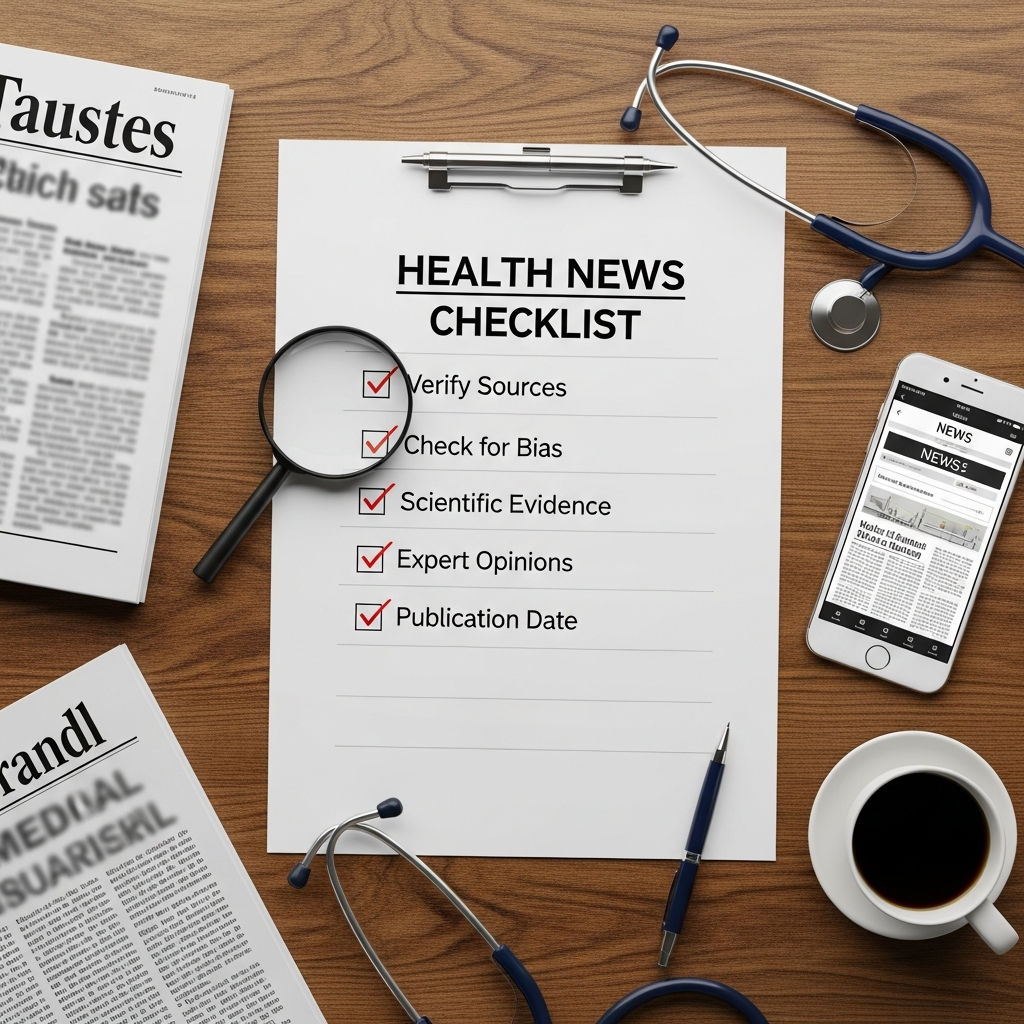
The Essential Health News Checklist (Summary)
Before you believe, buy, or broadcast health news, run it through this quick checklist:
- Source: Is it from a peer-reviewed journal or a trusted medical body?
- Subjects: Was the study done on humans or animals?
- Scale: Were there enough participants (hundreds vs. dozens)?
- Funding: Is there a clear conflict of interest?
- Comparison: Does the article mention the limitations of the study?
- Tone: Is the language objective or sensationalist?
- Context: How does this fit with what we already know about the topic?
Why Media Literacy in Health Matters
The goal of being a critical consumer of health news isn’t to become a cynic who rejects all science. Rather, it is to become an empowered patient. When you can distinguish between a preliminary lab finding and a major clinical breakthrough, you can make better decisions for your family.
Medical science is constantly evolving. What we “know” today may be refined tomorrow. However, by using a systematic checklist, you can protect yourself from the “whiplash” of contradictory health headlines and focus on the lifestyle changes that are actually backed by robust evidence.
Final Thoughts
Next time you see a shocking health claim on your newsfeed, take a breath. Don’t click “share” immediately. Open the article, look for the link to the original study, and ask the hard questions. Your health—and your peace of mind—are worth the extra five minutes of investigation.
Note: This article is for informational purposes only and does not constitute medical advice. Always consult with a qualified healthcare professional before making changes to your medical treatment or diet.
“`